
6/27/23
I started this blog about a year ago. At that time, as a person who loved golf and reading about golf, I felt that there wasn’t enough golf writing that resonated with me as an African-American golfer. I found that reading about golf was kind of like being on a diet. What I read provided sustenance (as I said, I love golf, and there was plenty written about golf), but it didn’t fulfill me or my need to be recognized as an African-American golfer who had a different perspective and experience than a traditional Euro-American golfer. So, I thought that I would write a monthly blog from my personal perspective. To be clear, I do not represent the diaspora of African-American golfers (a miscalculation made often by non-African-American golfers), but at least I was lending my written voice to a different (maybe not so different?) perspective than the “traditional” one.
Recently, I heard a wonderful sermon by one of my favorite televangelists, Rev. Andy Stanley. He is white (and about my age), but from what I have gleaned, is sensitive to multi-cultural and multi-generational points of view. In fact, he bases most of his teaching on the premise that we all have much more in common (as children of God) than we don’t. However, from his perspective, it is more profitable in today’s America to highlight our differences and divide us. His talk was about the significance of Independence Day in 2023 in America and what it means to different groups. The gist of his sermon was that our differences, highlighted by those who stand to profit by that division, were dividing us in ways that were going to cause our country to implode. Despite current and popular rhetoric, America is not defined by one narrow point of view. No American is more “American” than another. We are Americans, period, with all of our diversity and talents. His plea was that we come to our senses and find our beneficial commonality before it’s too late.
That sermon and point of view got me to thinking about golf. I have played in all kinds of settings. I have probably played with every type of perspective in humanity (and at all venues from the most mundane municipal course to the highest-end private course) over the last nearly forty years. Currently, as I have written about before, I really enjoy my affiliation with the Black Diamonds, an all-black, male group in Baltimore, MD who play every Sunday whenever the weather is accommodating. We don’t all think alike, live alike, or look alike (again, a miscalculation of non-African-Americans), but we have cultural and ethnic connections that make playing and socializing together, especially in a game historically known for its exclusion of our group, a great joy devoid of “cultural distraction.” I always feel supported and protected by my black golfing brothers wherever we play. There is comfort in numbers and solidarity! We can be ourselves, bring our culture (and music nowadays in golf), and feel perfectly comfortable. When we play together, we don’t care how we might appear to non-African-Americans. We are serious golfers. So, in that vein like all serious golfers, we respect and abide by the etiquette and traditions of the game. However, what I have observed when I play with the Black Diamonds, as opposed to predominantly white golf groups, is that whatever tension there might be naturally around race, does not exist. I am very comfortable and enjoy playing with my non-African-American friends who are golfers, but situations can arise that bring racial tension into the picture when the group is is not all African-American. That is not the case when I play with the Black Diamonds. In fact, since we have several foursomes playing at once, we have strength in numbers. In addition, if one of us feels that something is “racially amiss” when we’re playing, then we all “raise our antennae.” There is comfort in numbers and familiarity. If I am playing with non-African-American players, that sensitivity is not naturally present. Understand that I didn’t say that non-African-American players can’t have that sensitively (my close non-African American friends have often felt my discomfort or disrespect and been very supportive). However empathy, although appreciated, is not quite the same as inflicted pain. Lastly, I alluded to musical/cultural particulars. Recently, I played in an event where I was the only African-American golfer out of over two hundred male players. Conversations, behavior, etc. were pretty similar to when I’ve been in events with all African-American golfers. However, musical tastes were quite different. In the 21st Century, golfers are golfers! That’s a great blessing that I have compared to when my father started playing in the 1950s. However, if you want to notice clear cultural differences on the golf course, listen to the music being played. All groups play music, but the diversity of that music is distinctive and defining. Having noticed those differences, I also notice similarities. Golfers love golf and music. So, are we really that different?
Getting back to the to the original question. Do differences cause clashes? I think that differences identify unique tastes, not necessarily clashes. If you’re in a group who plays country music as opposed to hip-hop, are those groups approaching golf that differently? They are playing golf and music. If you decide that the best way to make par on a par 5 is lay up to about the 100 yard mark on your second shot (my choice, by the way), and your playing partner decides it’s better to go for the green in two, aren’t you both still playing golf and trying to make the best score? Difference does not have to mean clash. Lots of “roads lead to Rome.” Some roads may be more comfortable than others, but as soothing and desirable as comfort is, a little discomfort is good for fulfilling growth and development. Diversity, in all respects, is a worthy and enhancing goal, especially in golf, given its history. Don’t hide in and only experience your comfort zone. Embrace and enjoy golf in all its diverse fullness!
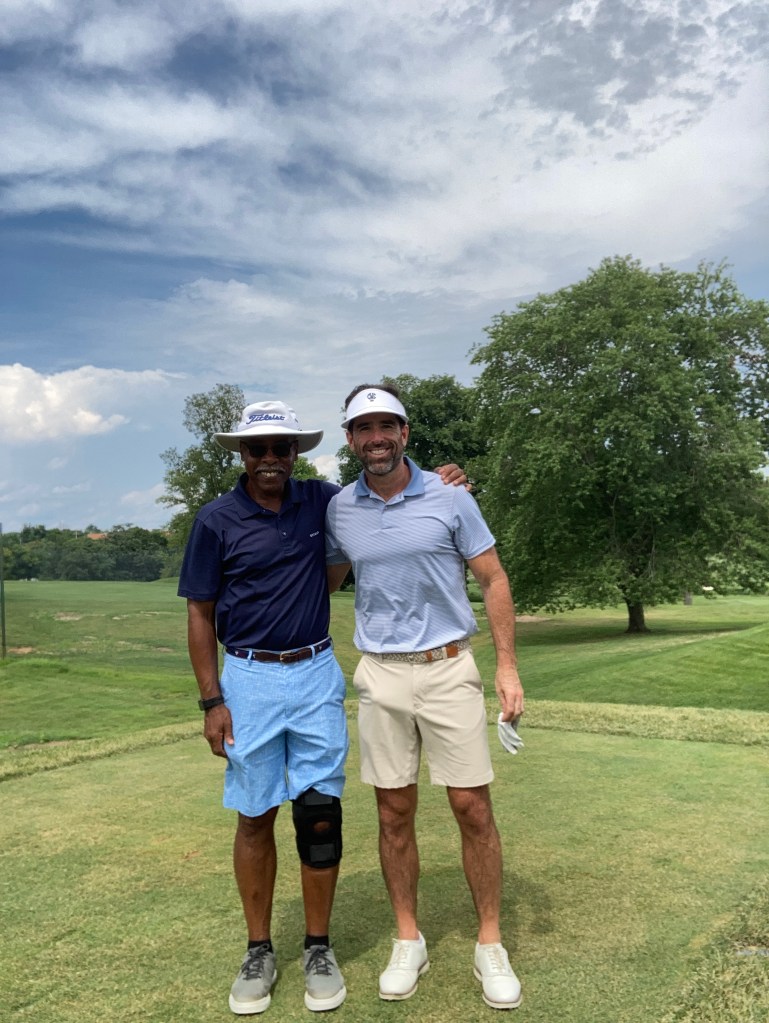
 Perspectives from an Average Black Golfer
Leave a comment