
10/13/22
In my previous post, I wrote about the historical and cultural foundations of black golf clubs in America. In general, these clubs formed as an alternative to the exclusion faced by black golfers from white clubs and courses. While those exclusions have moderated greatly in the last two to three decades, black golf clubs have flourished and remained viable over that time. The “need” for these clubs has changed over the years. In today’s culture and climate, black golf clubs serve mostly as a cultural social club with golf as the binding activity. Even for most black golfers who now have access to predominantly white clubs, the experience of belonging to or participating in predominantly black clubs serves as a familial bond akin to membership in a black church or black fraternity/sorority (Greek life).
My personal history is a “mixed bag” regarding racial/cultural exposure. When I was a young boy in the 1960s, Baltimore, MD was a segregated city. Neighborhoods were very homogenous. The only time that neighborhoods had mixed races and cultures was when they were in transition between groups. The neighborhood where I grew up was an exclusively white neighborhood in the 1950s but by 1970, it was exclusively black. Growing up in that neighborhood, my friends were all black. However, my parents sent me to private schools where the population was predominately white. So, I learned to “get along” in both environments. As I mentioned in an earlier blog, my father was a golfer, but I didn’t start playing until I was an adult, despite his encouragement for me to take the game up as a boy. In the 1960s and 1970s, golf was not a sport most black kids played. Like most boys in my neighborhood, I played football, basketball, and baseball. I had close black friends in my neighborhood and in school, but culturally, I had little intimate contact with black culture. I attended a predominately white school and church. It wasn’t until I went to college, which was also a predominately white institution, that my cultural exposure became more black. I still had white friends, but I hung with a close-knit group of black friends throughout my four college years. I did not join Greek life (my father, mother, and youngest brother were Greeks), but my college group of black friends effectively immersed me into black culture to a much larger degree than had been the case in my childhood.
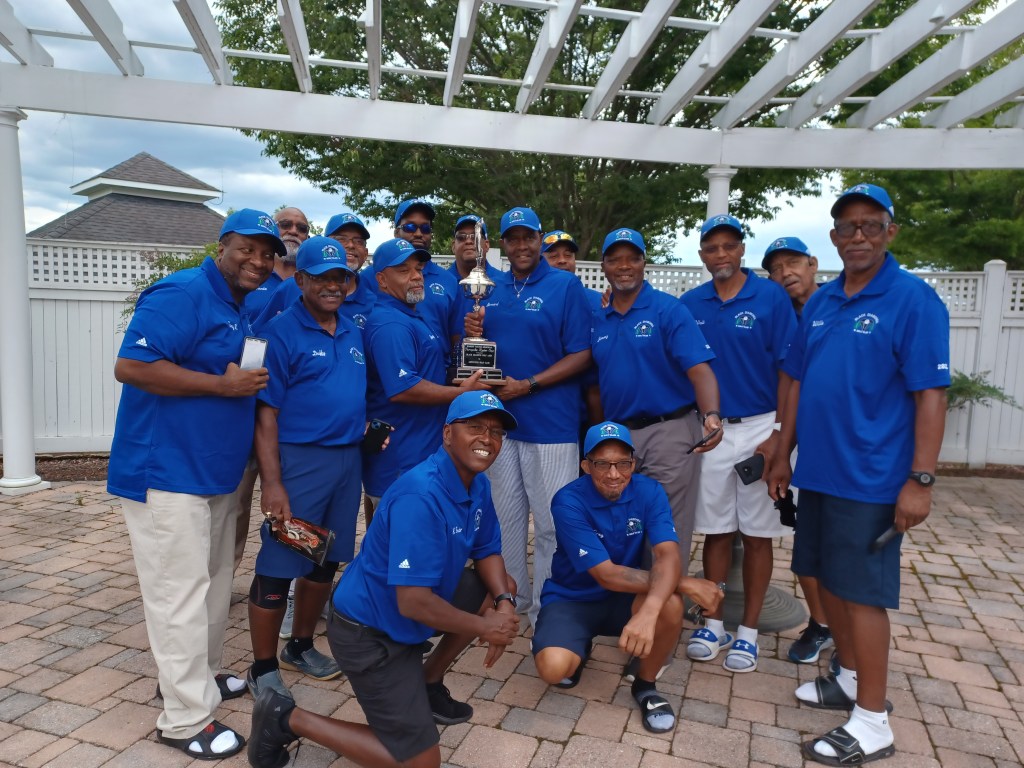
Given my background, when I started to play golf in my mid-twenties, I played in a mostly multi-racial environment. There were times when I was the only black player in my group, and there were times when there were no white players in my group, and everything in between. My golf life was pretty informal, as well. I hardly played in organized competitions. I just played with my friends, black, white, or whomever. My golf life remained that way until I was in my sixties. At the age of sixty-one, I joined the Black Diamonds. This was a club that had been around for at least a couple of decades. It was a social group of about fifty members dedicated to golf and made up of 99% black men. It was one of those organized, golf clubs that had risen out of the ashes of segregated golf years ago.
My “Black Diamonds experience” has been tremendous. I have lots of new golf buddies who share my enthusiasm for the game. We meet every Sunday (in almost any weather) at a different public course and have competitions just like any other golf group or private club. Normally, there are about 20-30 players each Sunday. The club is made up of different ages, occupations, perspectives, and skill levels. In addition to the golf benefits, what I have really enjoyed is the camaraderie. Black people are not monolithic. Within the Black Diamonds, there are many points of view, agreements, and disagreements. What I feel, though, is a sense of commonality and the safety of “shared understanding.” More simplistically, I feel a sense of a “golf family” in the Black Diamonds. Much like other social organizations, our common passion for one thing binds us in unique ways with other things. In general, I don’t think that these feelings are unique to black golf clubs. I know of golfers who love playing with their friends at their private clubs, especially the ambiance and social connections associated with those experiences. For me, the Black Diamonds offer the same sense of belonging. As a Black Diamond, I have experienced fun golf, a greater cultural identity, and affectionate brotherhood. That combination is a pretty good formula for happiness, especially in my latter years! I still play golf with a very diverse group of friends and am thankful for that blessing, but I am also thankful for the gift of being a Black Diamond.
 Perspectives from an Average Black Golfer
Leave a comment